


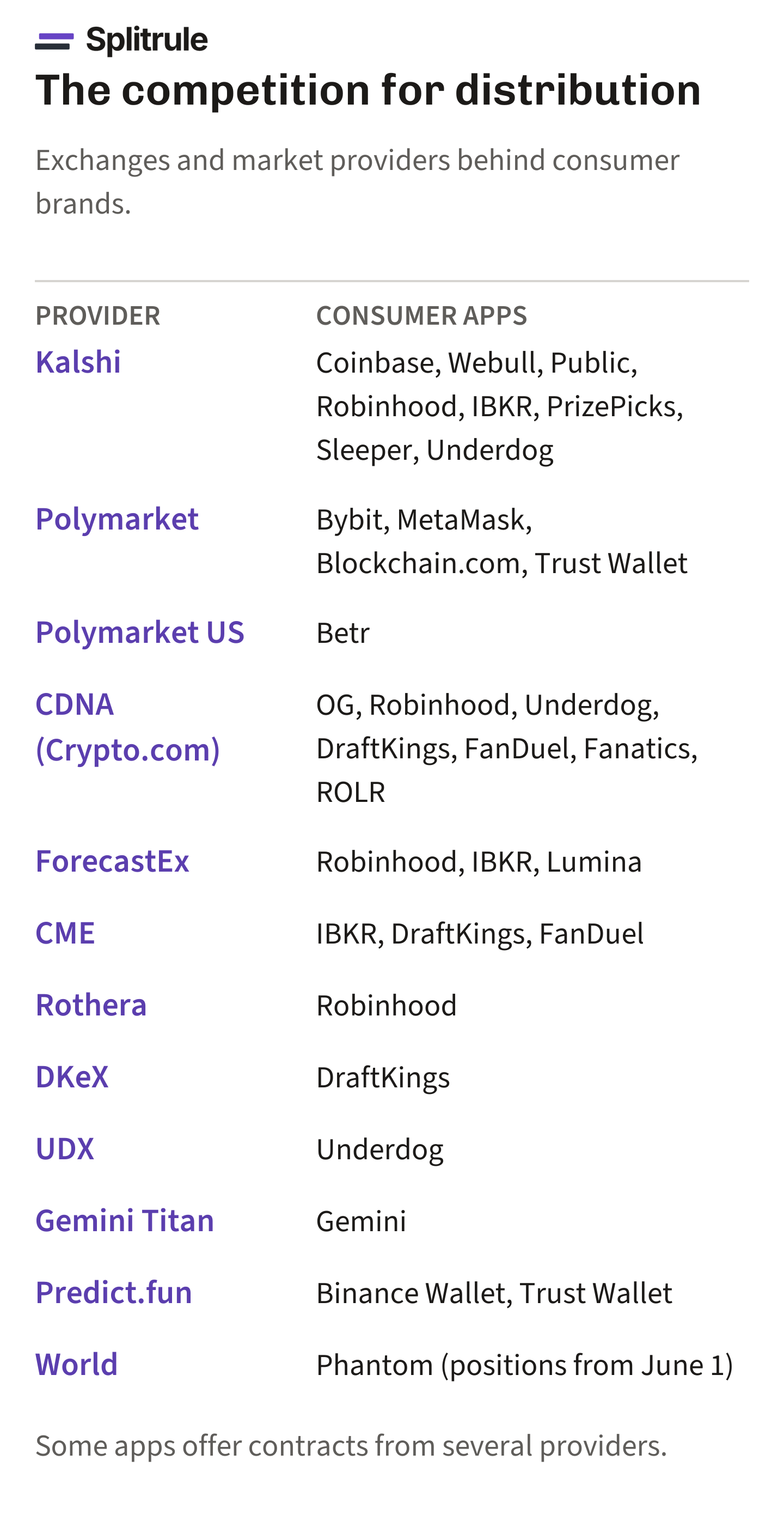
Kalshi reaches customers through brokerages such as Coinbase and Webull, and through sports apps such as PrizePicks and Sleeper. Polymarket appears inside Bybit, MetaMask, and Trust Wallet, while Betr uses the separate Polymarket US exchange. These relationships put prediction markets in front of audiences the exchanges would otherwise need to reach themselves.
The distribution map is broader than those two rivals. Crypto.com’s exchange, CDNA, supplies contracts to several sports brands and to its own OG app, and ForecastEx reaches customers through Interactive Brokers (IBKR), Lumina, and Robinhood. Some apps offer several providers while owning an exchange themselves. PrizePicks, which lists Kalshi markets today, has also announced a Polymarket partnership. A distribution deal can therefore expand an exchange’s reach without securing all of an app’s trading activity. The published routes show where that competition takes place; they do not tell us how much volume each relationship delivers. [1], [2]
Explore the companion map for the market access, ownership, clearing, and liquidity relationships behind these apps.
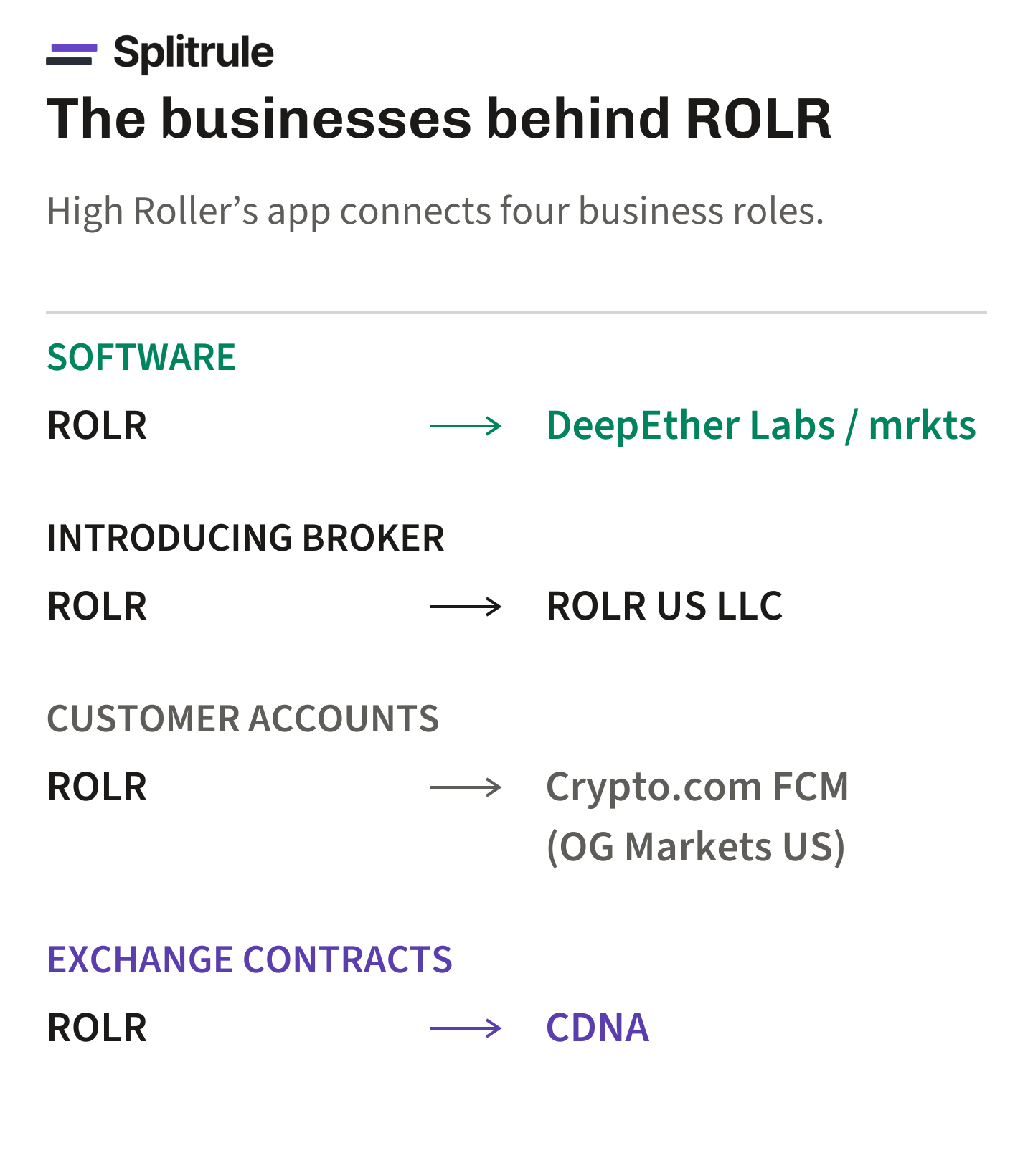
ROLR, the newest app on the map, launched on October 21. Behind High Roller’s customer app sits a chain of brokers and market infrastructure. ROLR US introduced customers to OG Markets US, doing business as Crypto.com FCM, which carried their accounts and funds. The contracts came from Crypto.com | Derivatives North America, or CDNA. [3]
High Roller also secured source-code rights and development support from DeepEther Labs, the business behind mrkts. That arrangement let it build the customer experience using licensed software while relying on other firms to carry accounts and operate the exchange. [4]
ROLR gave CDNA another channel for trading activity and gave High Roller a product for its audience. Their June agreement made CDNA the exclusive contract provider on High Roller’s US platform for the agreement’s first 24 months and anticipated revenue sharing, although it gave no percentage. [5]
A launch like this creates competition for the customer relationship around an existing trading pool. The app can attract users and earn revenue from their activity while the exchange continues to provide the place where orders meet. Following those relationships helps explain how so many prediction-market brands can emerge around a smaller set of venues.
The customer relationship has its own economics
Lumina discloses how this arrangement works in unusually clear terms. It uses IBKR exclusively to carry accounts and ForecastEx exclusively for trading. ForecastEx belongs to IBKR Group, and Lumina and IBKR Group share common individual control through Thomas Peterffy. [6]
Consider 100 ForecastEx contracts bought at 40 cents each. Lumina charges a one-cent exchange fee per contract, plus a commission of 0.35% of trade value. IBKR’s published direct-client schedule, which can vary by account, lists the same ForecastEx exchange fee with no commission. [7], [8]
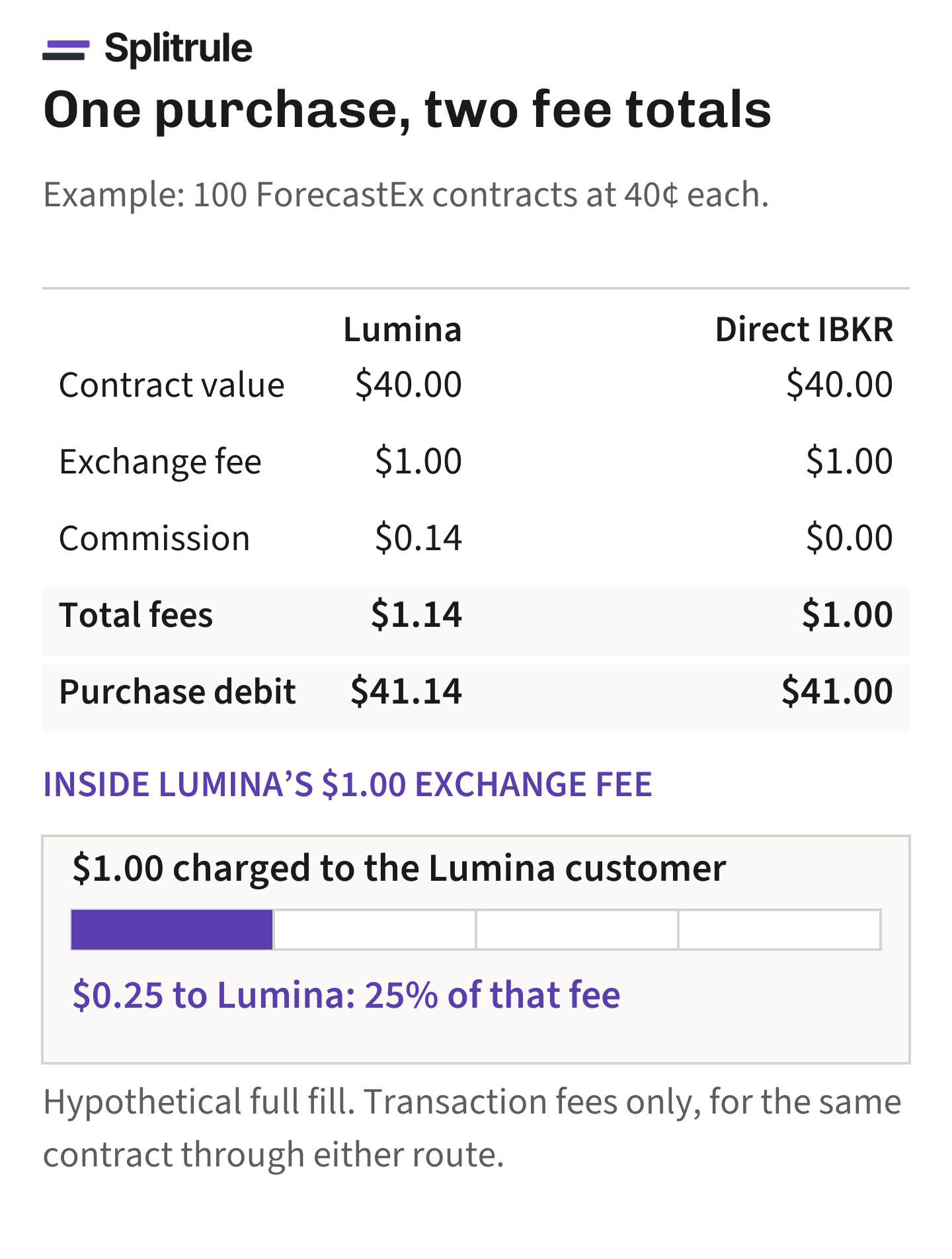
Of the dollar in exchange fees charged to the customer in this example, Lumina receives 25 cents. IBKR also retains an undisclosed portion of Lumina’s commission, so the published charges reveal more about the customer’s cost than either firm’s eventual profit. [6]
The extra 14 cents pays for Lumina’s app and service on top of a venue that IBKR clients reach directly.
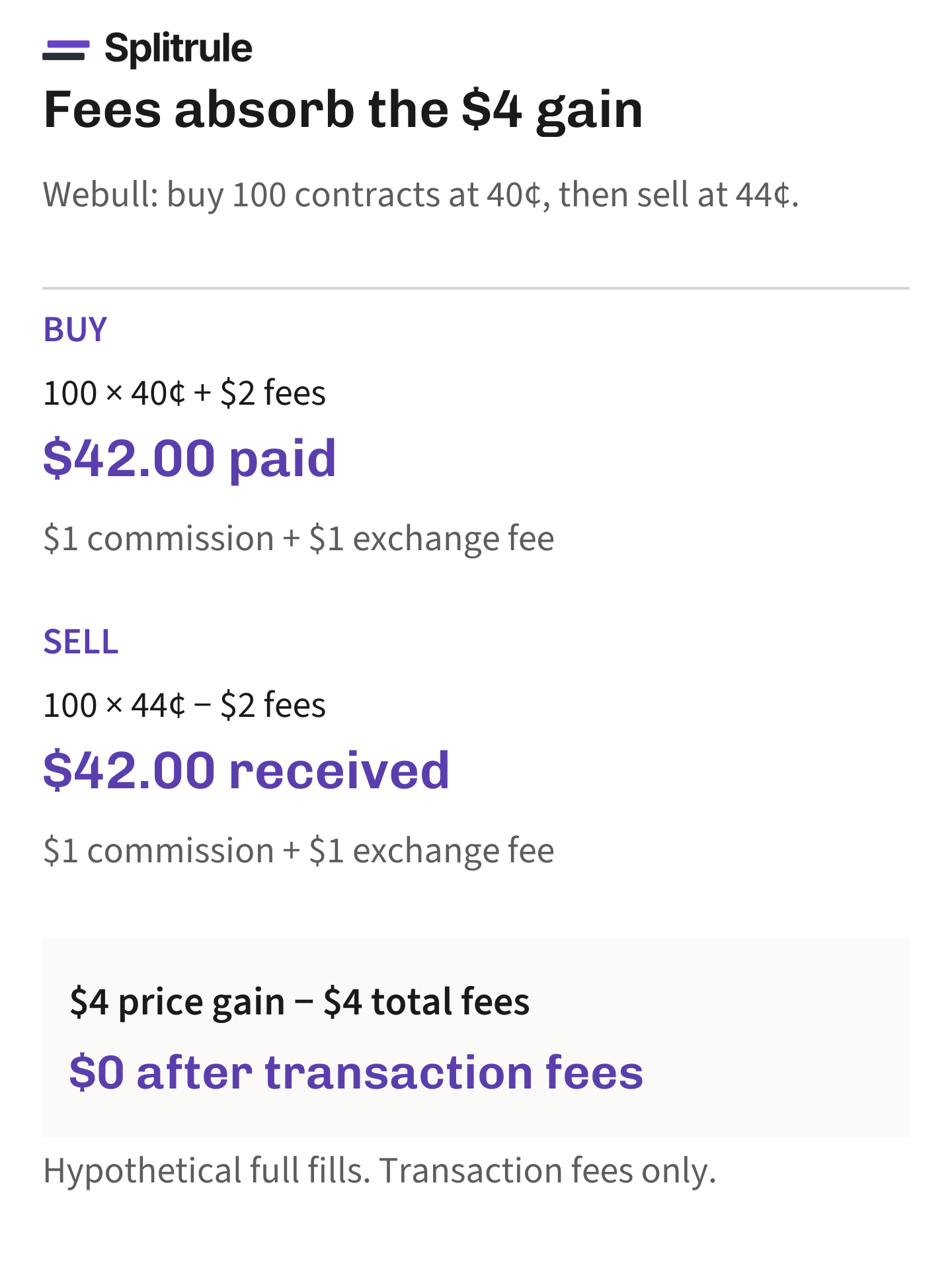
The exit can matter as much as the entry. Webull charges one cent in commission and one cent in exchange fees per contract on each trade. In a hypothetical round trip, 100 contracts bought at $0.40 cost $42 with fees. Selling all 100 at $0.44 returns $42 after fees: a $4 gross gain becomes zero after $4 in transaction charges. Holding through settlement has no additional settlement fee under the same schedule. [9]
Liquidity is a separate relationship
In institutional trading, a venue and a liquidity provider can each play a part in the same transaction. Cantor’s August announcement describes its introducing-broker role for Kalshi block trades, where clients can negotiate a single price away from the central order book. Susquehanna Predictions provides pricing and liquidity for that service. [10]
BitGo’s March offering gives customers a bilateral, over-the-counter event-linked derivative with BitGo as their counterparty and Susquehanna Crypto providing liquidity. Customers can post digital assets as collateral, though the disclosure leaves BitGo’s hedge venue unidentified. [11]
Susquehanna also appears in Robinhood’s Rothera joint venture, which is a different relationship from providing liquidity for a customer trade. A map that labels all of these connections as partnerships would lose the distinction between owning infrastructure and supplying prices. [12]
Polymarket’s builder documentation describes app orders matching through its central limit order book. The app’s attributed activity can therefore be the same trading activity recorded by the exchange, which matters when adding up volume across brands. [13]
Betr uses the separate Polymarket US book and usually displays its bid-ask midpoint as the probability, switching to the last trade when the gap exceeds ten cents. A customer comparing its screen with another app needs the price available for their order to judge the cost of trading. [14]
Shared software can serve different pools
Matchbook’s B2B customers can use its exchange technology with either shared liquidity or a ring-fenced market structure. That choice allows products built on the same software to offer different pools of counterparties. [15]
Its World Cup campaign provides a named example: PredictStreet used Matchbook technology and shared an account and wallet with its exchange. The June–July campaign establishes that deployment, while leaving its current operating status and precise degree of order-book sharing unconfirmed. [16]
Plaee combines software with access to CDNA’s contracts and liquidity. BitMart US announced a Plaee-powered product embedded in its platform, but its customer announcement leaves the exchange and carrying entity unnamed. The software connection alone doesn’t fill in those missing parts of the trading arrangement. [17], [18]
Plaee’s announced ProphetX integration, still described as beta, adds another potential venue to its offering. Each operator’s deployment would need to show whether its customers actually use that connection. [19]
Ownership expands the choices
Brands can own infrastructure while continuing to distribute outside contracts. Several published arrangements show both:
Robinhood. Its Rothera affiliation coexists with Kalshi, ForecastEx, and CDNA access. It also said it will hold equity stakes in Crypto.com and OG.com after OG’s spin-off. [20], [21]
DraftKings. It owns DKeX; its terms also name CME and CDNA. [22], [23]
Underdog. It owns UDX while retaining Kalshi and Nadex (CDNA) access. [24], [25], [26]
Fanatics. Its Water Street Labs and CX Clearinghouse acquisition closed August 5. Published retail terms still name CDNA; a migration is unverified. [27], [28]
Owning an exchange gives a distributor more control over the economics of a trade, while outside venues can supply contracts or liquidity its customers still want. These businesses have kept both options available, though their disclosures don’t show how trading activity divides among them.
The firms responsible for customer accounts and clearing add another layer to these arrangements. An account provider holds funds and positions, while a clearinghouse, or DCO, manages settlement and the obligations between trading parties. Public identifies both its own entity and Apex Clearing as futures commission merchants, or FCMs; DraftKings names Wedbush as a clearing FCM that acts through the applicable clearinghouse. [29], [23]
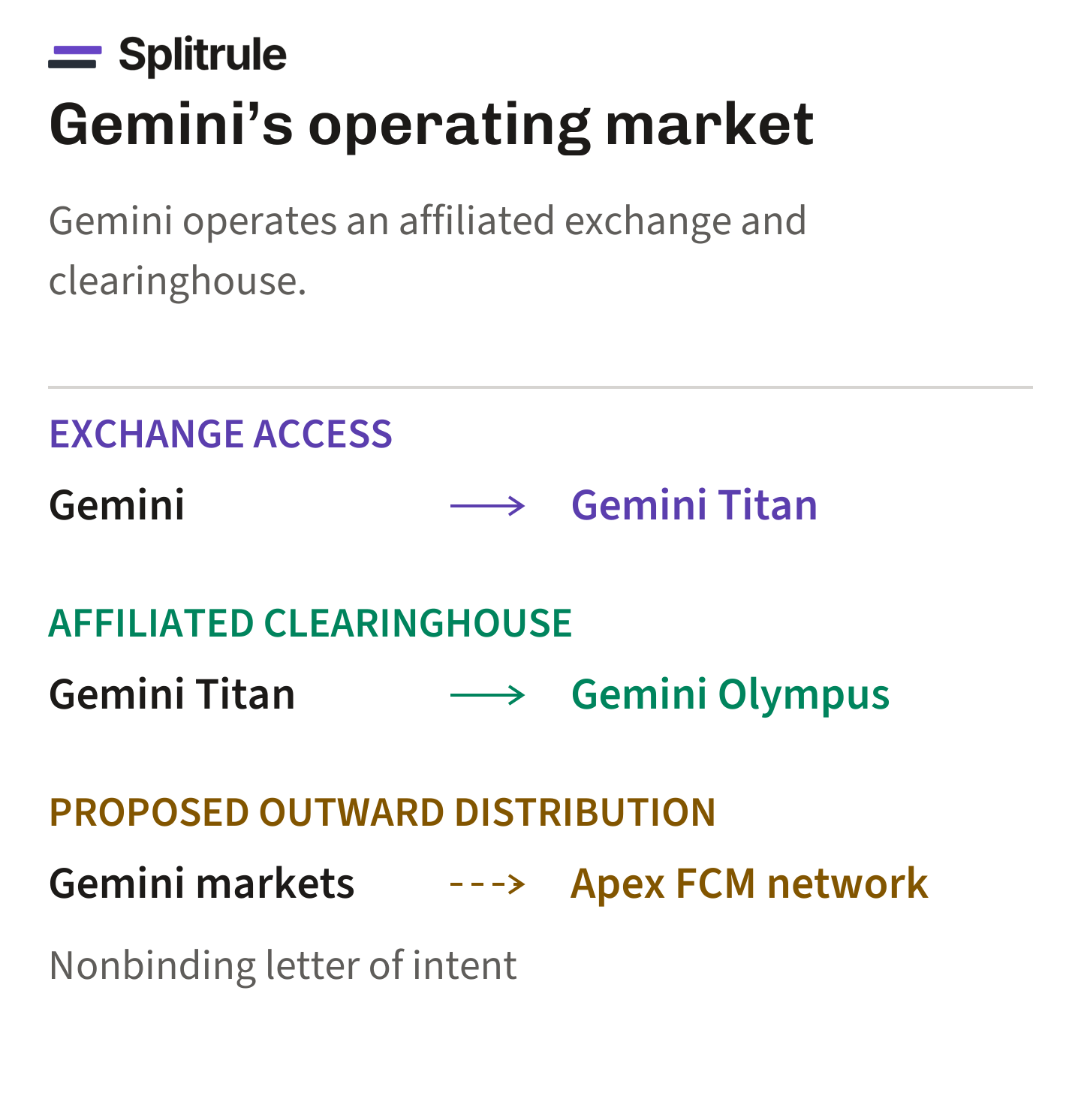
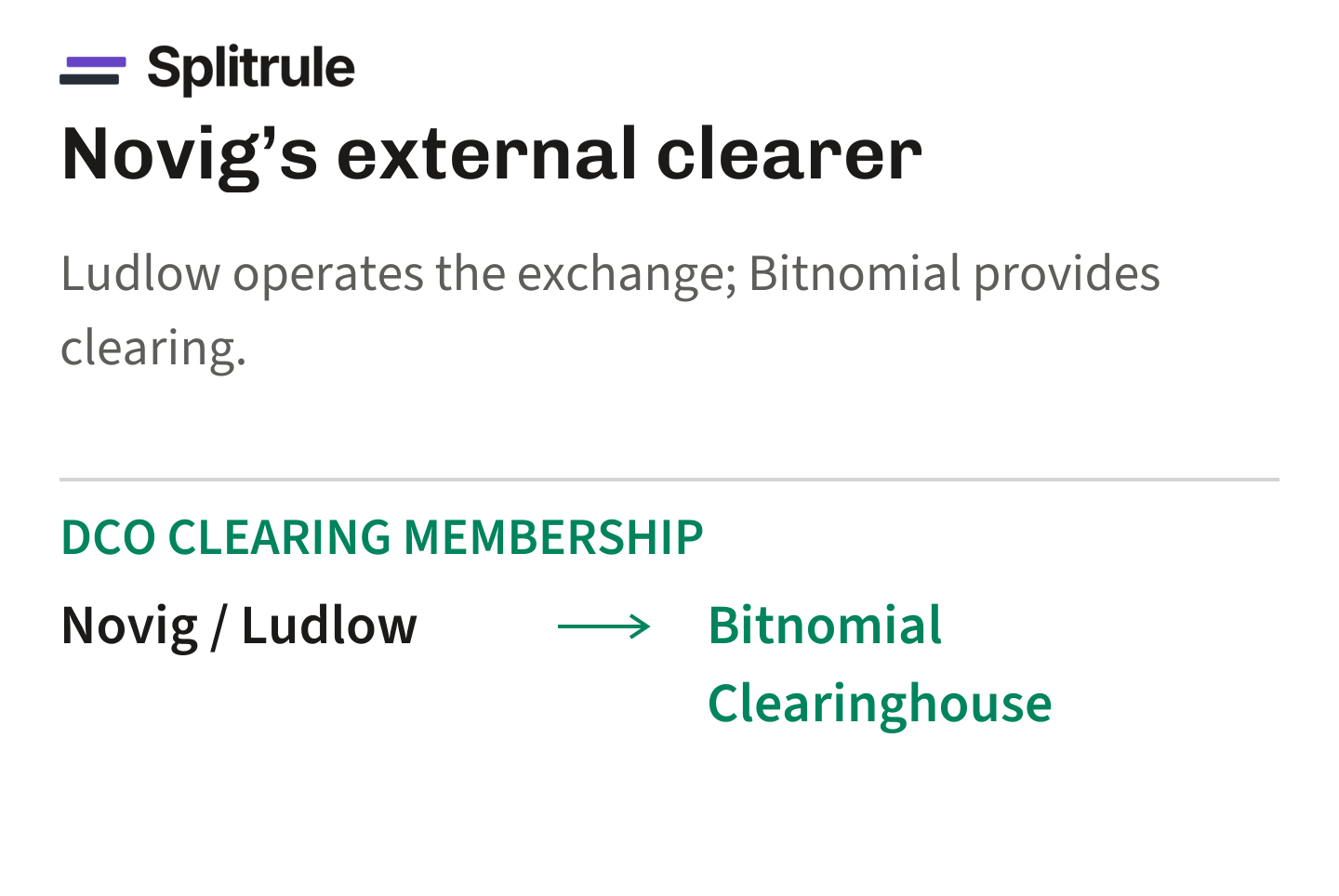
Gemini operates the Titan exchange. Its affiliated Olympus clearinghouse began operating on August 4, according to Gemini, bringing those functions into the same corporate group. Its nonbinding letter of intent with Apex proposes another source of customers through Apex’s FCM. Novig uses a different structure, with Ludlow operating the exchange and external Bitnomial Clearinghouse providing clearing membership. [30], [31], [32], [33]
Two applications now pending at the CFTC take different routes to clearing. Nasdaq MRX Futures applied on October 26 to become a designated contract market, and its proposed rulebook names the Options Clearing Corporation as its clearing corporation. OCC is an established clearinghouse that Nasdaq shares with other exchange groups, so the new market would plug into shared infrastructure in which Nasdaq already has a stake. The proposed contracts are binaries on year-over-year headline and core CPI that would pay $100 or nothing. [34], [35], [36]
Forum Markets Group has applied for both an exchange, ForumEX, and a clearinghouse, Forum Clearing, and owns each outright. Forum describes itself as an attention market, and its proposed contracts work differently from a binary that pays once: they would settle against an index at the end of every trading day and, by default, roll into the next day’s contract. [37], [38], [39], [40], [41]
Coinbase completed its acquisition of The Clearing Company in January, and Coinbase Clearing LLC registered as a DCO on September 28. Coinbase’s consumer help still names Kalshi as the market operator, so Kalshi remains the retail route customers can verify today. [42], [43], [44]
Data, wallets, and resolution add other relationships
ICE distributes Polymarket’s market information without handling customer trades. It launched normalized data feeds in February through its existing data services, whose terms explicitly exclude trading on or linking through to Polymarket. Alongside ICE’s investment in the company, those feeds create a commercial relationship around the information the market produces. [45], [46], [47]
Phantom’s disclosure makes the date a position opened important to tracing its route. Positions opened before June 1 used Kalshi through DFlow; later positions use World, which routes to Solana liquidity providers and redeems automatically. The disclosure leaves those providers’ hedge venues unidentified. [48]
Resolution adds another relationship to trace. Polymarket’s documentation distinguishes UMA resolution from Chainlink TWAP resolution for up/down markets, so even contracts on the same venue can use different mechanisms to determine a payout. Sharing one of those services tells us how an outcome is determined, while the contract’s own rules still define what the customer holds. [49]
For a customer choosing between apps, the practical comparison starts with the contract and the rights it carries, then the executable price, available size, and fees on entry and exit. The same venue can cost different amounts through Lumina and IBKR, and Matchbook’s choice of pools means shared software doesn’t establish shared liquidity.
For Kalshi, Polymarket, and the exchanges competing with them, much of the contest now runs through these relationships. A new app can become an exclusive channel, as ROLR is for CDNA under its current agreement, offer contracts from several providers, or build an exchange of its own while keeping outside access. ROLR’s app owns the customer relationship and shares in revenue, while other firms supply its software, accounts, and contracts. The companion map follows those connections so readers can see which parts of a trade each business controls.
References
PrizePicks: prediction-market exchange and regulatory documents
High Roller: prediction-market software agreement with DeepEther Labs
High Roller SEC exhibit: CDNA exclusivity and revenue-sharing agreement
Lumina: conflicts of interest, IBKR relationship and revenue sharing
Interactive Brokers: event-contract commissions and exchange fees
Cantor: institutional Kalshi block trading with Susquehanna liquidity
BitGo: institutional prediction-market offering and liquidity arrangements
Robinhood: World Cup contracts and the Rothera joint venture
Matchbook: PredictStreet World Cup campaign and shared account access
Plaee: regulated prediction-market infrastructure partnership with CDNA
BitMart US: launch of its Plaee-powered prediction-market offering
Robinhood: Crypto.com partnership and planned Crypto.com and OG.com equity stakes
DraftKings: prediction-market terms, exchanges and account arrangements
Underdog: supported exchanges and differences in customer access
SEC filing: Fanatics acquisition of Water Street Labs and CX Clearinghouse
Fanatics Markets: introducing-broker terms and CDNA relationship
Public: prediction-market offering and account-provider disclosures
Gemini: second-quarter 2026 results and Olympus clearinghouse operating update
Nasdaq MRX Futures: proposed rulebook and CPI binary contracts
Forum Clearing: corporate ownership structure filed with the CFTC
ForumEX: proposed rulebook, daily settlement and contract rolling
SEC Form 4: Coinbase acquisition of The Clearing Company and merger consideration
Coinbase: consumer prediction-market disclosure naming Kalshi
ICE: launch of Polymarket Signals and Sentiment data services
ICE: Market Signals and Sentiment service terms and trading restrictions
ICE: announcement of a new $600 million investment in Polymarket