


October 14, 2026. Supporting research by Splitrule.
Microsoft’s July 29 earnings call produced two answers to an apparently simple question: was cybersecurity mentioned? Kalshi’s final record says No while Polymarket’s says Yes.
The complete official transcript contains one occurrence of “cybersecurity,” in a question from Deutsche Bank analyst Brad Zelnick. No company speaker or operator uses that word, a plural or possessive form, or a spaced or hyphenated variant in the written transcript. Satya Nadella does use “cyber” and names containing it, which are different expressions. Microsoft transcript.
The retrieved contract descriptions draw a consequential distinction. Kalshi counts company representatives, including the operator; Polymarket counts anyone during the event. The transcript supports that explanation for the opposing results. Establishing the adjudicators’ reasoning would also require the applicable historical rules and original audio. Kalshi historical records, Polymarket final record.
The economic consequence depends on which sides someone holds. Kalshi Yes combined with Polymarket No produces no contract payout at those outcomes. Reverse the sides and both contracts win. Describing either position as “Yes on one venue and No on the other” hides the direction of the exposure.
A public earnings-market comparison had already identified Microsoft and six other candidates. This research checked five of them and found opposing final records in all five. The other two were not checked.
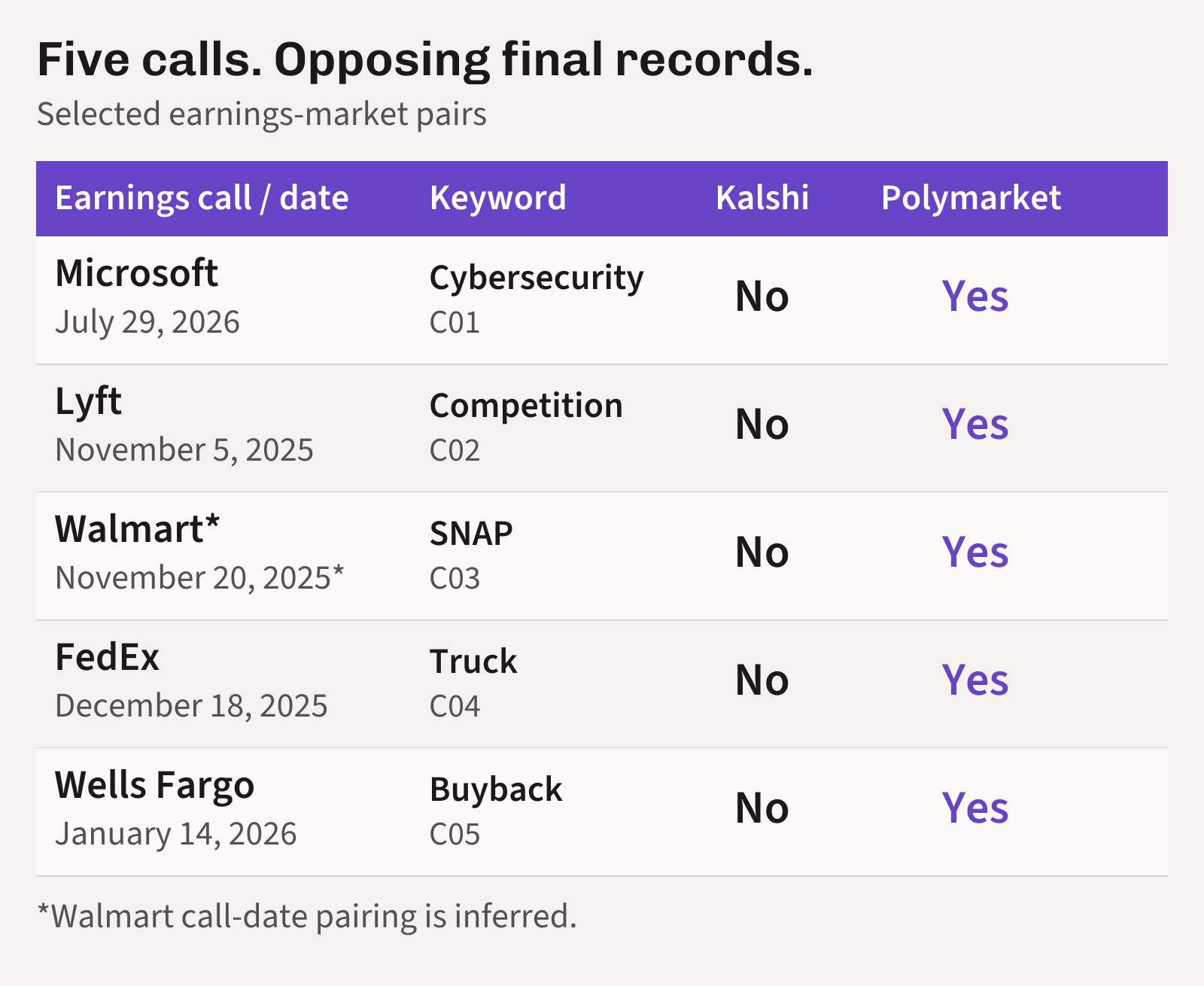
Walmart’s Kalshi event still carries the March 31, 2026 date from its ticker as its subtitle. Its trading dates, and its place in Kalshi’s Walmart series between the August 2025 and February 2026 calls, point to the November 20 call instead. The FedEx and Wells Fargo events also carry later ticker dates, but their subtitles name the call dates.
These were flagged cases, so the table cannot show how often such contracts disagree. No single cause is proven for all five, either. Kalshi’s summary rules require the exact word or its plural or possessive, while the four older Polymarket descriptions also count compound words. A compound such as “truckload” could therefore separate the FedEx results without any difference in speakers.
Start with the possible payouts
Suppose each contract has a maximum payout of $1. Let A be the first venue and B the second. The two possible combinations produce these gross payouts, before purchase costs and fees:
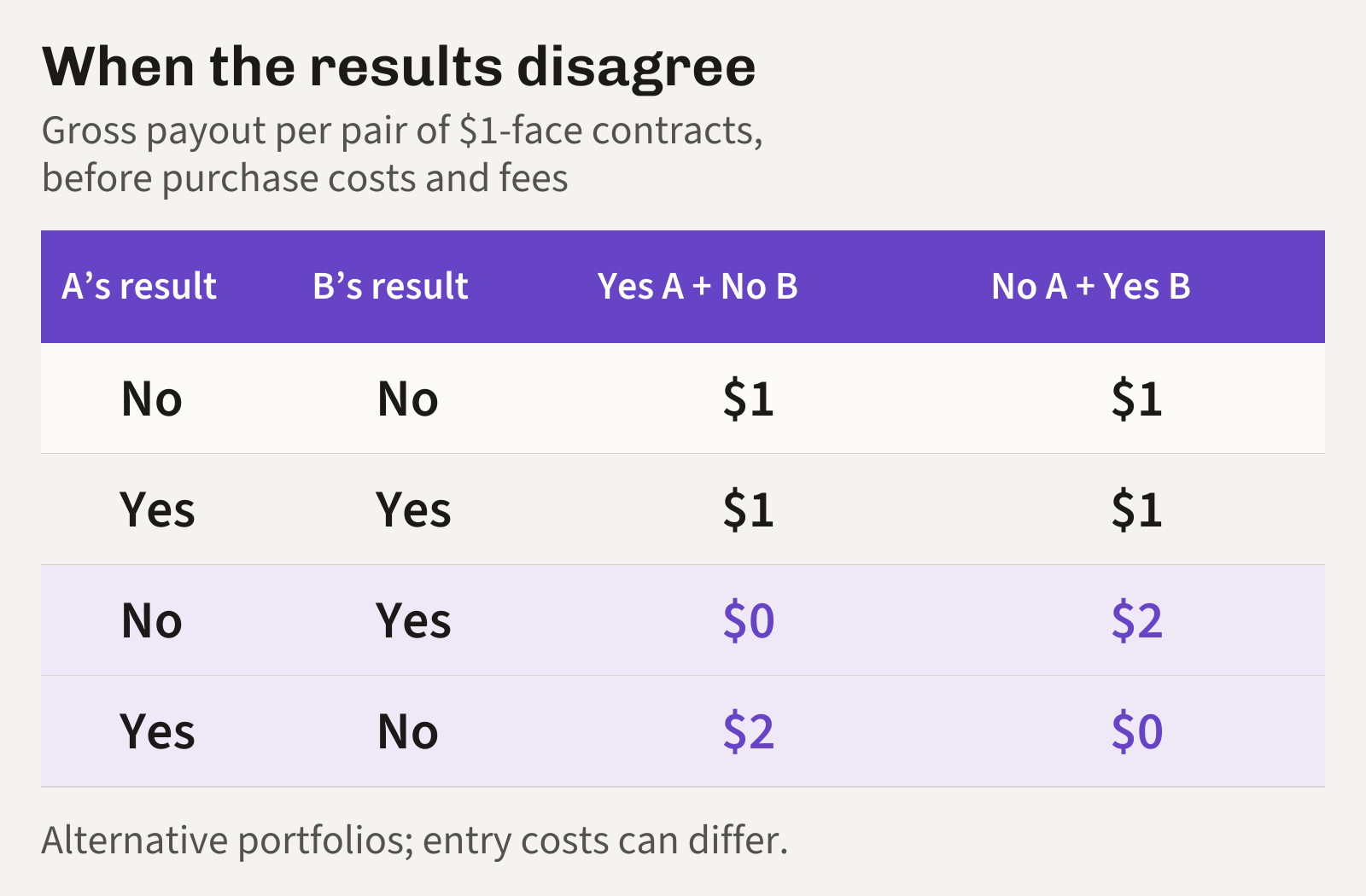
These are alternative portfolios, with potentially different entry costs. The table does not establish that either was available below $1.
If one condition is narrower than another, disagreement can be directional. A company representative is also someone on the call. Counting anyone can therefore produce Yes when counting only representatives produces No. Holding every other rule constant, that speaker distinction alone cannot produce the reverse disagreement. Event windows, phrase definitions, resolution sources, and cancellation provisions can introduce other differences.
Consider an invented purchase of 100 Kalshi Yes contracts and 100 Polymarket No contracts for $90 in total. Matching binary results return $100. The recorded Microsoft outcomes return zero, leaving a $90 loss before fees. The price is hypothetical; the payout calculation uses the recorded results.
The same logic explains why that pair can look cheap. Under the simplified speaker comparison, Polymarket’s Yes covers every case that Kalshi’s Yes covers and more, so it can fairly trade higher. Under those assumptions, Kalshi Yes plus Polymarket No can cost less than $1 because it pays nothing in the extra cases that only Polymarket counts.
A contract can settle between zero and one
Cardi B’s Super Bowl halftime appearance illustrates a partial payout. Kalshi’s contract, KXPERFORMSUPERBOWLB-26-CAR, covered a performance at the game or an announcement that she would perform. Its current record marks the strike as suspended under Kalshi Rule 13.1, with a scalar settlement of $0.26 for Yes. Polymarket’s contract asked whether she would perform live and in person during the halftime show. It resolved Yes, with a $1 payout per winning unit. Kalshi historical records, Polymarket final record.
Kalshi Yes plus Polymarket No therefore returns $0.26 per pair. The reverse position returns $1.74: $0.74 from Kalshi No and $1 from Polymarket Yes. A position can have a partial payout even when the records do not contain opposite binary answers.
The two venues reached those values by different routes. Front Office Sports reported on February 10 that Kalshi found the performance ambiguous and settled at its last-traded price, which it treated as fair value. Kalshi’s record shows that settlement late on game night, February 8, Eastern time. Polymarket’s Yes was disputed after the show, and its resolved record has a February 12 close time, also in Eastern time. The records do not show which rule versions applied to earlier trades, so the lesson here rests on the final values.
Different definitions do not always produce different results
The Hantavirus contracts inspected on October 14 illustrate a difference that exists before an outcome. Kalshi asks whether Hantavirus becomes a Public Health Emergency of International Concern in 2026, using the World Health Organization as its source. Polymarket requires an explicit WHO pandemic characterization and says a PHEIC alone is insufficient. Both contracts were open at the morning inspection. Kalshi contract, source designation, Polymarket description.
If the WHO makes the qualifying PHEIC declaration without the required pandemic characterization before the deadline, the descriptions point to Kalshi Yes and Polymarket No. Kalshi No plus Polymarket Yes then pays zero. That conditional scenario reverses the losing direction in the earnings examples; it is not a forecast about the outbreak.
The Bitcoin pair for October 14, 11:00–11:15 a.m. Eastern names different reference prices. Kalshi compares sixty-second averages of CF Benchmarks’ BRTI before the start and end of the window. Polymarket names Chainlink’s BTC/USD sixty-second TWAP stream and resolves Up when the TWAP “of the time range” is at least the price at its beginning. Kalshi listing, Polymarket listing.
Those measures can finish on different sides of their starting values. In this particular window, however, the final records agree: Kalshi No and Polymarket Down. A September Bitcoin study by Benny Ricciardi reports divergent windows elsewhere; that sample was not reproduced here. Different sources create the possibility of disagreement without ensuring that it occurs.
Refunds and half payouts differ
A refund returns what a position cost, whereas a fixed 50-cent settlement returns half the face value whatever the position cost. They can produce different cash returns even when both are casually described as cancelling a bet.
For an invented example, suppose a $1-face Yes position costs 30 cents and the opposing No position at another venue costs 60 cents. If the first venue refunds the 30-cent purchase cost while the other contract continues, the portfolio eventually returns either 30 cents or $1.30. Against its original 90-cent cost, that means a 60-cent loss or a 40-cent gain before fees. A 50-cent settlement of the first leg would instead return 50 cents or $1.50, a 40-cent loss or a 60-cent gain. In both cases the remaining contract still determines the result.
A useful comparison records the exact contract, eligible event or statistic, source, cutoff, and payout under each relevant exception. It also separates the event deadline from the time trading closes, review finishes, and funds become available.
For each proposed pairing, write down a plausible disagreement scenario and calculate both legs together. A price gap takes on a different meaning when the position can return zero, a partial amount, or a refund that leaves one leg exposed.
Scope: selected public records inspected October 14, 2026. Polymarket means its international platform. The methods and sources explain the calculations, identify the contracts, and record the evidence limits. Recorded outcomes were checked against venue APIs; customer receipts and blockchain redemptions were not audited.